
Damaged wheel? Here’s how to decide what to do
Just steered the wrong way and your alloy has an ugly scrape. You quickly think that the entire alloy needs to be resprayed, but not every bit of damage calls for a professional repair. With the right diagnosis, you can fix a lot of cosmetic damage yourself within a quarter of an hour.
This article helps you determine what kind of damage you have, when you can tackle it yourself, and when it is better to go to a specialist.
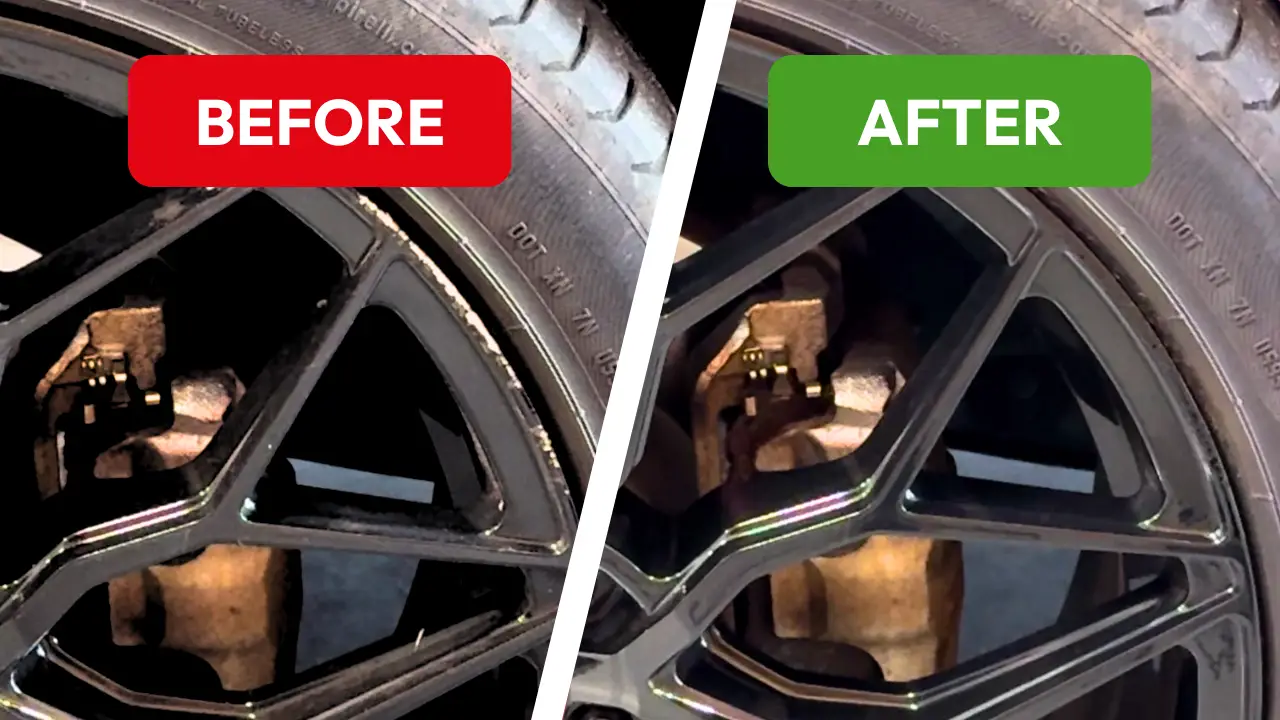
What type of damage do you actually have?
Alloy wheel damage comes in five main forms. The type largely determines which route is logical.
- Superficial scratches are only in the clear coat. The wheel still looks uniform, but there are dull scratches or streaks where the shine is gone.
- Deep scratches or scuffs running down to the paint layer or the aluminium. On a black wheel, you will then see a light grey or almost white stripe. This is the most common form of kerb damage.
- Dents in the wheel rim caused by a hard impact, for example a deep pothole or a high kerb. The rim is locally deformed. If you notice vibrations while driving, the balance may have been affected.
- Cracks are more serious. A crack can occur due to a heavy impact and can affect the construction of the rim. Continuing to drive with a crack is unwise.
- Corrosion or oxidation is a gradual process, not acute damage. Moisture and salt eat away at spots where the clear coat has worn off. First you see a white bloom, then pitting can occur.
For most people, the damage falls into the first or second category: a graze after contact with a kerb. The rest of this article focuses on that situation.
When you can sort it out yourself, and when you can't
- Do it yourself for superficial scratches, scuffs up to about 5 mm wide and minor rim damage that has only affected the top coats of paint. You can repair this within a quarter of an hour per wheel.
- Go to a spray painter's for larger scraped areas, or if the damage is so deep that an entire section of the wheel rim is missing.
- Go to an alloy wheel specialist In the event of dents or the suspicion of a crack. Straightening or welding a alloy wheel is work for someone with the right equipment and experience. If in doubt, you can send a photo to almost any company for free advice.
- Replace the alloy wheel for large cracks or wheels that have already been repaired multiple times. Especially with premium brands, that is worth considering.
Safety first. If you are in any doubt about the construction of the rim, have the damage assessed before you go back on the road.
How much does repair by a professional cost?
Professional alloy wheel repair ranges from approximately €80 to €250 per wheel depending on the method, and for a set of four you multiply that by four. The complete price comparison per repair type, from polishing to powder coating and CNC machining, can be found in our article about alloy wheel repair costs.
The Recarfix solution for cosmetic wheel damage
For superficial to medium cosmetic damage, the Recafix alloy wheel patch is an affordable alternative. Recarfix makes self-adhesive microfilm patches sprayed in the original factory colour of your wheel.
A patch consists of an ultra-thin foil, about as thick as a human hair, sprayed with a paint system approved by car manufacturers and finished with clear coat. You therefore effectively get a piece of factory paint back in the place where it was damaged.
A set costs €27.95 and contains 6 patches, enough for multiple types of damage. The patches are precut into a curved shape that fits the rim, and cut at a specific angle so the transition is practically invisible. At a distance of 30 cm you cannot see the patch.
The patch is car wash-proof 48 hours after application and lasts for 2 to 4 years. Removal is possible with a hair dryer. The product is made in Haarlem. It is not an import and not dropshipped.
Recarfix keeps patches in stock for 40+ car brands, including Audi, BMW, Mercedes, Tesla, Volkswagen, Porsche, Range Rover and Volvo.
Choose the Recarfix patch for your brand
Step-by-step plan: repair yourself with a patch
Application takes about 15 minutes per wheel. Do you want to see it first? On How does it work the instructional video is there.
- Clean the wheel rim and make sure it is grease-free. If there is baked-on brake dust around it, first use a alloy wheel cleaner. Rinse the residue with water and rub dry.
- Lightly sand away any burrs or large scratches. This is optional, but the smoother the surface, the better the finish. Start with 120 grit and optionally switch to a finer grit. Tape off the undamaged parts so you do not make any new scratches.
- Clean the area again after sanding. The surface must be completely free of dust and grease once more.
- Locally heat the rim with a hair dryer at the spot where the patch will go. In cold weather, this helps to ensure a good bond.
- Peel the patch off the backing sheet. Hold it by the corner and carefully stick it over the damaged area. Press down from the centre towards the edges so that no air bubbles get trapped underneath.
- Heat the patch for a few more seconds with the hair dryer. The microfilm will then mould itself precisely to the profile of the rim.
Is it specifically about curb damage? Then the full scenario is set out in repair kerb damage yourself. If you have black wheel rims, read this touch up black rims.
Alternatives that you will come across
Choosing a patch is not an anti-graffiti story. For some situations, other solutions are more logical.
- Touch-up paintsuitable for very minor stone chips where the colour is not critical. Often disappointing for wheels, as the clear coat is missing and the colour match is an approximation.
- Spray shop or alloy wheel servicethe right choice for larger or structural damage, or if you want a different colour on the alloy. Turnaround time about a week.
- CNC turning: for diamond-cut wheels where the polished aluminium is damaged. Please note that a wheel can only be machined a limited number of times before too little material remains.
- Replacein the case of cracks or multiple old repairs, sometimes wiser. Always ask for the price of a new rim first before choosing an expensive repair route.
- Recarfix patch: cosmetic damage where the colour needs to match precisely and you want to fix it yourself.
None of these options is the best in all situations. Which one suits your damage depends on what has happened and how critical it is.
Frequently asked questions about a damaged alloy wheel
Is a slightly damaged wheel dangerous to drive with?+
Not in the case of superficial cosmetic damage. If you suspect a dent or a crack, have the alloy wheel inspected before driving again.
How long does a Recarfix patch last?+
2 to 4 years under normal driving conditions. The patch is UV-resistant and car wash proof 48 hours after application.
Does a patch also work on a diamond-cut alloy wheel?+
Yes, for various brands. The match for diamond cut is 90 to 95 percent and not exact, because the machined aluminium has no colour code. For painted and powder-coated wheels, the colour is exact.
How much does it cost to have a wheel rim repaired by a spray painter?+
Expect around 100 to 250 euros per wheel for cosmetic work. A whole set will therefore quickly add up.
Can I go through the car wash with a Recarfix patch?+
Yes. 48 hours after application, the patch is car wash-proof.
Recarfix provides patches for 40+ car brands in the exact OEM colour. Find your brand and colour, order within 2 minutes and repair your alloy wheel yourself for 27.95 euros.
Choose the Recarfix patch for your brand